


A dead battery is one of those problems everyone eventually runs into—and usually at the worst possible moment. Whether you left the lights on, parked in cold weather, or haven’t driven in a while, knowing how to jump-start properly can save time, stress, and potential damage.
This is a practical, no-nonsense guide based on common real-world scenarios—not a checklist you have to memorize.
Before you grab cables or a jump starter, confirm that you’re actually dealing with a drained battery.
Common signs:
Clicking when you turn the key or press Start
Dim or dead headlights / dashboard
Electronics responding slowly or not at all
Loose or corroded battery terminals
⚠️ Do not jump the car if you smell sulfur (rotten eggs), see swelling, cracks, or leaks. That battery needs replacement, not a boost.
Jump-starting is simple, but batteries store serious energy.
Turn everything off before connecting anything.
Remove rings, watches, or metal jewelry.
Use cables or clamps that are clean and undamaged.
If your vehicle has special battery access or instructions (common in modern hybrids/EVs), check the owner’s manual first.
This still works—but only if done correctly.
Park the vehicles close without touching.
Red clamp → dead battery positive (+).
Red clamp → good battery positive (+).
Black clamp → good battery negative (–).
Black clamp → unpainted metal ground on the dead car (like a bolt on the engine block, not the battery itself).
Start the good car, wait a minute.
Start the dead car.
Disconnect in reverse order.
Once running, let the car run or drive for 15–30 minutes.
This only applies to manual cars.
Key to ON.
Clutch fully in, second gear.
Push to get rolling.
Release clutch smoothly while giving light throttle.
If it starts, drive immediately to recharge.
This is the easiest and safest option if you drive solo.
Steps:
Car off.
Red clamp → battery positive.
Black clamp → chassis ground (or negative terminal if specified by the device).
Power on the jump starter.
Start the car.
Power off and remove clamps (reverse order).
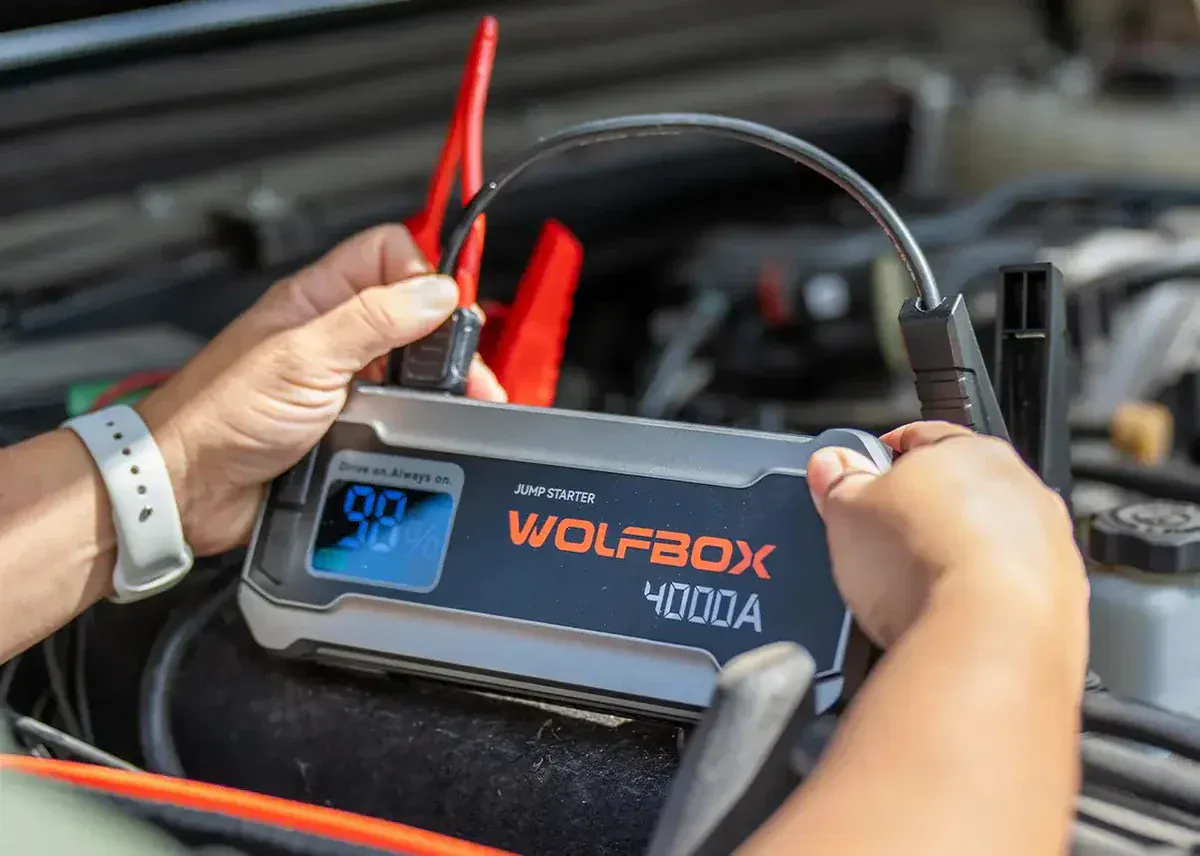
Many drivers keep a compact jump starter in the vehicle so they don’t need a second car. Units like our Wolfbox MegaVolt 24 are designed to handle multiple jump starts on a single charge, which is peace of mind in a glovebox.
Getting the engine running is only step one.
Drive if possible: This recharges the battery faster than idling.
Watch for repeat failures: If it dies again tomorrow, the battery is likely failing, not just discharged.
Check battery age: If it's 3+ years old, it might be time for a swap.
Clean terminals: Corrosion blocks power flow.
Method
Typical Time
Jumper cables
5–10 minutes
Portable jump starter
3–5 minutes
Push start
1–3 minutes
Approximate jump-start requirements:
Vehicle
Recommended Amps
Compact cars
200–300A
Sedans / SUVs
400–600A
Trucks / Vans
700A+
Most modern portable jump starters (including ours) exceed these minimums significantly.
Have you found portable jump starters reliable long-term, or do you still trust traditional cables more? Any cold-weather survival stories worth sharing?
